
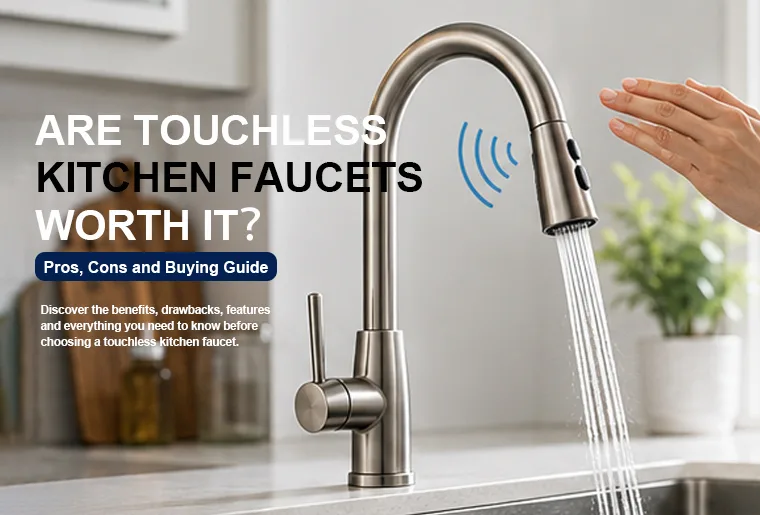
Are Touchless Kitchen Faucets Worth It? Pros, Cons and Buying Guide
Meta Description
Are touchless kitchen faucets worth it? Discover the pros, cons, features, costs, maintenance tips, and how to choose the best touchless faucet in 2026.
The kitchen faucet has evolved far beyond a simple fixture for delivering water. In 2026, homeowners are increasingly looking for smart kitchen faucets, touchless technology, water-saving features, modern designs, and improved convenience.
One of the most popular innovations is the touchless kitchen faucet.
Instead of touching a handle every time you need water, a motion sensor allows you to turn the faucet on and off with a simple wave of your hand. This can be particularly useful when your hands are covered with food, grease, flour, or other messes.
But are touchless kitchen faucets really worth the extra cost?
The answer depends on how you use your kitchen, your budget, and the quality of the faucet you choose.
In this comprehensive guide, we’ll explain how touchless kitchen faucets work, their advantages and disadvantages, how much maintenance they require, how they compare with traditional and touch-activated faucets, and what to look for when buying one in 2026.
Are Touchless Kitchen Faucets Worth It?
Yes, a touchless kitchen faucet can be worth it if convenience, hygiene, and hands-free operation are important to you.
They are especially useful for people who cook frequently and regularly handle:
- Raw meat
- Fish
- Dough
- Vegetables
- Greasy ingredients
- Cleaning products
Instead of touching the faucet handle with dirty hands, you can activate the water using a motion sensor.
However, touchless faucets are not automatically better for everyone. They typically have more components than a conventional faucet, including sensors, batteries or power systems, solenoid valves, and electronic controls.
That means buyers should pay close attention to product quality and serviceability.
The 2026 U.S. Houzz Kitchen Trends Study found that 45% of renovating homeowners purchasing new faucets selected at least one special feature. Water efficiency was the most popular special feature at 24%, followed by touch control at 19%, while touch-free activation was selected by 5%.
This suggests that touchless technology is an established premium feature, but water efficiency and practical functionality remain even broader priorities.
What Is a Touchless Kitchen Faucet?
A touchless kitchen faucet is a faucet equipped with a motion sensor that detects the presence or movement of your hand.
When the sensor detects movement within its operating range, it sends a signal to an electronic control system. A valve then opens or closes the water flow.
Most touchless kitchen faucets still include a traditional handle.
The handle typically allows you to control:
- Water temperature
- Basic water flow
- Manual operation
The sensor is primarily used for convenient on/off control.
This is different from a touch-activated faucet, where you physically touch the faucet with your hand, wrist, or arm to start or stop the water.
How Does a Touchless Kitchen Faucet Work?
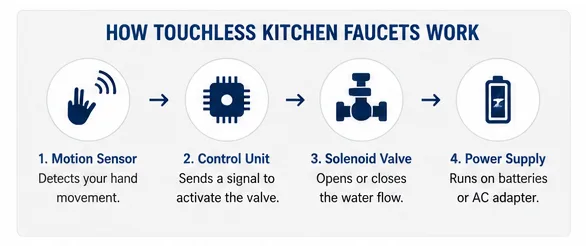
A typical motion sensor kitchen faucet contains several key components.
1. Motion Sensor
The sensor detects movement near the faucet.
Depending on the design, the sensor may be located:
- On the faucet body
- Near the base
- Around the spout
- Under the spout
2. Electronic Control Unit
The sensor communicates with a control module.
The module determines whether the faucet should open or close.
3. Solenoid Valve
The solenoid valve controls water flow electronically.
When activated, it allows water to flow. When the sensor is triggered again, the valve closes.
4. Power Supply
Touchless faucets usually require an electrical power source, such as:
- Batteries
- Rechargeable batteries
- AC power adapters
Battery-powered models are especially convenient for installations where electrical wiring is not available.
7 Major Benefits of Touchless Kitchen Faucets
1. Better Hygiene and Less Handle Contact
One of the biggest advantages of a hands-free kitchen faucet is reduced contact with the handle.
Imagine preparing raw chicken.
Your hands are contaminated with food residue, and you need to rinse them.
With a traditional faucet, you touch the handle, turn on the water, wash your hands, and then touch the handle again.
With a touchless faucet, you can simply wave your hand.
This can help reduce unnecessary contact with frequently touched surfaces.
For busy kitchens, this is one of the strongest reasons to consider a motion sensor faucet.
2. Convenient When Your Hands Are Dirty
Touchless technology is particularly useful when your hands are:
- Wet
- Greasy
- Covered in flour
- Holding a large pot
- Covered with food
- Dirty from gardening
Instead of struggling to operate a handle, you can activate the water with a simple hand movement.
This makes touchless faucets especially attractive for:
busy kitchens + frequent cooking + multitasking
3. Modern and Premium Kitchen Design
Touchless faucets are often associated with modern kitchen design.
Many models feature:
- High-arc spouts
- Pull-down spray heads
- Minimalist shapes
- Stainless steel finishes
- Matte black finishes
- Brushed finishes
This makes them a natural fit for contemporary kitchens.
The 2026 kitchen and bath product trends highlighted by Houzz also show continued interest in faucets that combine sculptural design with smart functionality, including touchless operation.
4. Potentially Reduce Unnecessary Water Use
A water-saving kitchen faucet doesn’t necessarily have to be touchless, but automatic shutoff can help prevent water from running unnecessarily.
For example, if you are:
- Washing vegetables
- Moving dishes
- Scrubbing a pan
- Preparing ingredients
you can activate the faucet only when water is needed.
Some touchless models also incorporate automatic shutoff features.
However, don’t assume that every touchless faucet automatically saves a specific percentage of water. Actual water consumption depends on:
- Flow rate
- User behavior
- Sensor settings
- Aerator design
- Duration of use
The 2026 Houzz study identifies water efficiency as the most popular special faucet feature, selected by 24% of renovating homeowners purchasing new faucets.
5. Easier Cleaning
A faucet handle can accumulate:
- Grease
- Food particles
- Soap
- Water spots
- Fingerprints
Reducing physical contact with the handle can make the faucet easier to keep clean.
A smooth stainless steel or quality PVD finish can further simplify maintenance.
For consumers searching for a low-maintenance kitchen faucet, touchless technology combined with a durable finish can be an attractive option.
6. Useful for Children and Older Adults
Touchless operation can also improve accessibility.
Children may have difficulty reaching or operating a stiff faucet handle.
Older adults or users with limited hand strength may also appreciate hands-free activation.
This makes sensor faucets worth considering for households that prioritize:
- Accessibility
- Ease of use
- Universal design
- Convenient kitchen operation
7. Works Well With Pull-Down Kitchen Faucets
One of the most practical combinations is a:
Touchless + Pull-Down Kitchen Faucet
A pull-down spray head provides flexible rinsing, while touchless operation controls the water without requiring handle contact.
This combination is particularly useful for:
- Large sinks
- Busy kitchens
- Washing vegetables
- Cleaning cookware
- Rinsing dishes
As a result, touchless pull-down kitchen faucets are an attractive product category for modern kitchens.
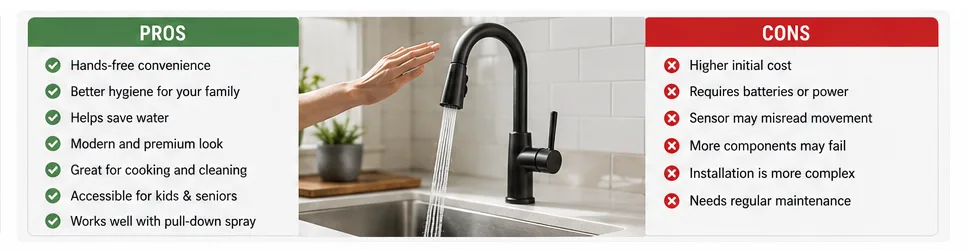
Disadvantages of Touchless Kitchen Faucets
Despite their advantages, touchless faucets aren’t perfect.
Before buying one, consider these potential disadvantages.
1. Higher Initial Cost
Touchless faucets generally cost more than basic manual faucets because they require additional components.
These may include:
- Sensors
- Control modules
- Solenoid valves
- Battery compartments
- Wiring
- Electronic components
If your main priority is the lowest purchase price, a traditional faucet may be a better choice.
2. Batteries Need Replacement
Battery-powered touchless faucets require periodic battery replacement.
How often batteries need replacing depends on:
- Battery capacity
- Usage frequency
- Sensor design
- Standby power consumption
For a busy household, battery maintenance is something you should consider before purchasing.
A good design should make the battery compartment easy to access.
3. Sensors Can Occasionally Misread Movement
Motion sensors are convenient, but they can sometimes:
- Activate unexpectedly
- Fail to detect movement
- Detect nearby objects
- Require positioning adjustments
Poor-quality sensors are more likely to cause frustration.
Therefore, sensor sensitivity and detection range are important buying considerations.
4. More Components Mean More Potential Failure Points
A traditional faucet may have relatively simple mechanical components.
A touchless faucet adds:
- Electronics
- Sensors
- Solenoid valves
- Power connections
More components can mean more potential maintenance requirements.
This doesn’t mean a touchless faucet is unreliable. It means product quality matters more.
Choose a manufacturer that provides:
- Replacement sensors
- Replacement solenoid valves
- Spare cartridges
- Battery components
- Technical support
5. Installation Can Be More Complicated
A traditional faucet installation is usually relatively straightforward.
A touchless model may require additional steps for:
- Sensor installation
- Control box installation
- Power connection
- Battery placement
- Wiring management
Always follow the manufacturer’s installation instructions.
Touchless vs Touch-Activated Faucets
Many buyers confuse touchless and touch-activated faucets.
They are not the same.
| Feature | Touchless Faucet | Touch-Activated Faucet |
|---|---|---|
| Activation | Motion sensor | Physical touch |
| Hands-free | Yes | Partially |
| Handle contact | Minimal | Still possible |
| Hygiene | Excellent | Good |
| Sensor | Required | Usually not motion-based |
| Batteries | Often required | Depends on model |
| Best For | Messy hands | Quick operation |
Touchless Faucet
Wave your hand.
Touch-Activated Faucet
Touch the faucet with your hand, wrist, or arm.
If your priority is minimizing contact, touchless is the better option.
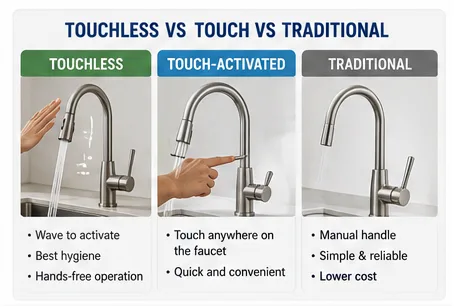
Touchless vs Traditional Kitchen Faucets
| Feature | Touchless | Traditional |
|---|---|---|
| Convenience | Excellent | Good |
| Hygiene | Excellent | Moderate |
| Initial Cost | Higher | Lower |
| Maintenance | Moderate | Lower |
| Electronics | Yes | No |
| Battery | Often required | No |
| Long-Term Simplicity | Moderate | Excellent |
Traditional faucets still have one major advantage:
simplicity.
If you want a faucet that is easy to understand, easy to repair, and does not require batteries, a high-quality manual faucet may be the better choice.
What to Look for When Buying a Touchless Kitchen Faucet?
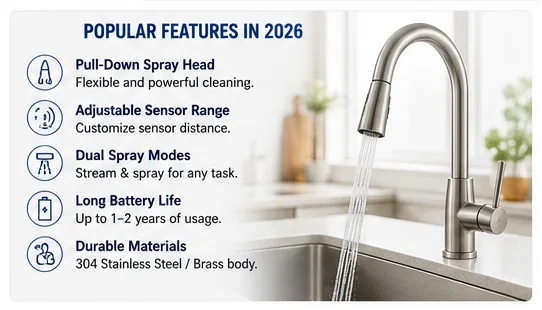
Not all sensor faucets are created equal.
Before buying, consider the following features.
1. High-Quality Motion Sensor
Look for:
- Reliable detection
- Adjustable sensitivity
- Stable response
- Appropriate detection range
2. Ceramic Cartridge
Even a touchless faucet often has a manual temperature and flow-control system.
A high-quality ceramic cartridge can provide smoother operation and help reduce leaks.
3. Durable Faucet Material
For long-term performance, consider:
304 stainless steel
It offers excellent corrosion resistance and is particularly suitable for modern kitchen faucets, especially in demanding environments. If you are choosing a faucet for a hard-water area, see our guide to [Best Kitchen Faucets for Hard Water] for more tips on materials, finishes, aerators, and maintenance.
You can also consider high-quality brass construction depending on the product design and target market.
4. Pull-Down Spray Head
A pull-down spray head can significantly improve functionality.
Look for:
- Stream mode
- Spray mode
- Easy docking
- Flexible hose
- Easy-clean nozzles
5. Easy Battery Replacement
If the faucet is battery powered, make sure the battery compartment is:
- Accessible
- Clearly designed
- Easy to open
- Protected from water
6. Manual Override
This is extremely important.
A good touchless faucet should ideally allow manual operation if:
- Batteries are depleted
- The sensor fails
- Electronic components require maintenance
This provides a useful backup and improves long-term usability.
Best Materials for Touchless Kitchen Faucets
Brass
Brass remains a widely used faucet material because of its strength and established plumbing applications.
It can be an excellent choice when properly manufactured and finished.
Zinc Alloy
Zinc alloy is often used for budget-oriented faucet products.
It can provide attractive designs at a lower cost, but buyers should carefully evaluate material quality and surface finishing.
If you’re comparing different faucet materials, see our guide to 304 Stainless Steel vs Zinc Alloy Faucets.
Are Touchless Faucets Worth It for B2B Buyers?
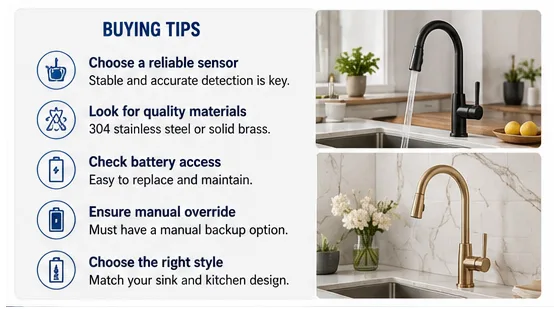
For wholesalers, distributors, builders, and importers, touchless kitchen faucets represent an opportunity to add a higher-value product category.
They can be positioned as:
- Modern kitchen faucets
- Smart kitchen faucets
- Premium kitchen faucets
- Hygienic kitchen faucets
- Water-saving faucets
The key is to avoid selling the product only as a “smart gadget.”
Instead, focus on practical benefits:
Convenience + hygiene + design + water efficiency + reliable operation
This is particularly useful for:
- New residential developments
- Hotels
- Premium apartments
- Modern kitchen projects
- High-end renovation projects
Industry market research also indicates growing interest in smart and touchless faucets among residential remodeling professionals, although figures vary by survey and methodology.
How Much Should You Spend on a Touchless Kitchen Faucet?
Price should not be the only factor.
Instead, compare:
Entry Level
Focus on:
- Basic sensor
- Simple design
- Battery operation
Mid Range
Look for:
- Better sensor performance
- Ceramic cartridge
- Pull-down spray head
- Durable finish
- Replaceable components
Premium
May include:
- Advanced sensors
- Smart-home integration
- Voice control
- Multiple sensors
- Premium stainless steel construction
- Advanced water management
The important thing is to buy according to your actual needs.
If you only want hands-free operation, you may not need expensive app or voice-control features.
Are Smart Kitchen Faucets the Same as Touchless Faucets?
Not necessarily.
A touchless faucet primarily means hands-free operation using a sensor.
A smart kitchen faucet may include additional technology such as:
- Voice control
- Measured water dispensing
- Mobile app functions
- Smart-home integration
- Water usage monitoring
Some products are both smart and touchless, while others are simply sensor-operated faucets.
For most homeowners, the most useful feature may simply be:
reliable touchless on/off operation.
Frequently Asked Questions
They can be worth the extra cost if you cook frequently, value hygiene, or want convenient hands-free operation. For occasional users who prioritize simplicity and low cost, a traditional faucet may be better.
They can help reduce unnecessary water use through convenient on/off operation and automatic shutoff, but actual savings depend on the faucet's flow rate and user behavior.
Most touchless faucets require a power source, commonly batteries or an AC adapter.
The answer depends on the model. Many faucets provide a manual override, but buyers should verify this feature before purchasing.
Touchless operation reduces the need to physically touch the faucet handle, which can be useful when preparing food or handling dirty ingredients.
Quality varies. Sensor quality, solenoid valves, power systems, manufacturing standards, and replacement-part availability all affect reliability.
Final Verdict: Are Touchless Kitchen Faucets Worth It in 2026?
So, are touchless kitchen faucets worth it?
For many modern kitchens, yes—but quality matters.
Touchless technology provides real practical benefits rather than being simply a decorative feature. It can make everyday kitchen tasks more convenient, reduce handle contact, improve accessibility, and complement modern kitchen design.
However, the best touchless kitchen faucet isn’t necessarily the one with the most technology.
A well-designed model should prioritize:
✔ Reliable motion sensing
✔ Durable faucet construction
✔ Ceramic cartridge
✔ Easy battery replacement
✔ Manual override
✔ Pull-down spray functionality
✔ Easy-clean finish
✔ Replaceable components
✔ Appropriate water flow
✔ Strong manufacturer support
The 2026 market is clearly moving toward faucets that combine functionality, efficiency, and smart features. Houzz’s latest research shows that water efficiency is currently a more common special faucet feature than touch-free activation, while current 2026 product trends continue to incorporate touchless operation into modern faucet designs.
Therefore, if you’re upgrading a busy kitchen, a touchless pull-down kitchen faucet with a durable construction and reliable sensor can be an excellent investment.
For a simpler and more budget-friendly installation, however, a high-quality 304 stainless steel manual kitchen faucet may still offer better value.
Ultimately, the right choice depends on your priorities:
Best for convenience: Touchless kitchen faucet
Best for hygiene: Touchless kitchen faucet
Best for simplicity: Traditional kitchen faucet
Best for budget: Traditional kitchen faucet
Best for modern kitchens: Touchless pull-down faucet
Best for long-term material durability: 304 stainless steel faucet
Best overall: A quality touchless faucet with reliable manual backup and durable construction